2026 breed risk report: The pets most likely to need emergency care in New Jersey and Staten Island
If outside the area, please call your nearest emergency vet.
Pet emergencies are stressful wherever they occur, and the risks and challenges can vary from one community to another. The GSVS Family of Hospitals surveyed 200 dog and cat owners across New Jersey and New York, to examine breed-related health awareness, the emergencies sending local pets to the ER, and how prepared owners are when those visits become more serious.
Throughout this report, figures describe all 200 New Jersey and New York respondents unless a Staten Island and nearby New Jersey comparison is stated. Where local residents are called out separately, that subset is 101 respondents.
Key takeaways
- Specific-breed cats' ER visits required a specialist 60% of the time, the highest of any local group.
- 45% of pet ER visits require a specialist, and flat-faced pets escalate the most, at 62%.
- Nearly half of owners (49%) can't name their pet's biggest breed-related health risk.
- Toxic ingestion hits local cats hardest, driving 23% of their ER trips.
- Staten Island and neighboring New Jersey pet owners are more than twice as likely as those elsewhere in New Jersey (31% vs. 13%) to believe popular breeds are healthier.
- 46% of Gen Z owners couldn't cover a $1,000 emergency without going into debt, compared to 12% of baby boomers.
A knowledge gap with a local twist
Local owners came into pet ownership with plenty of affection and, frequently, little breed-specific information.
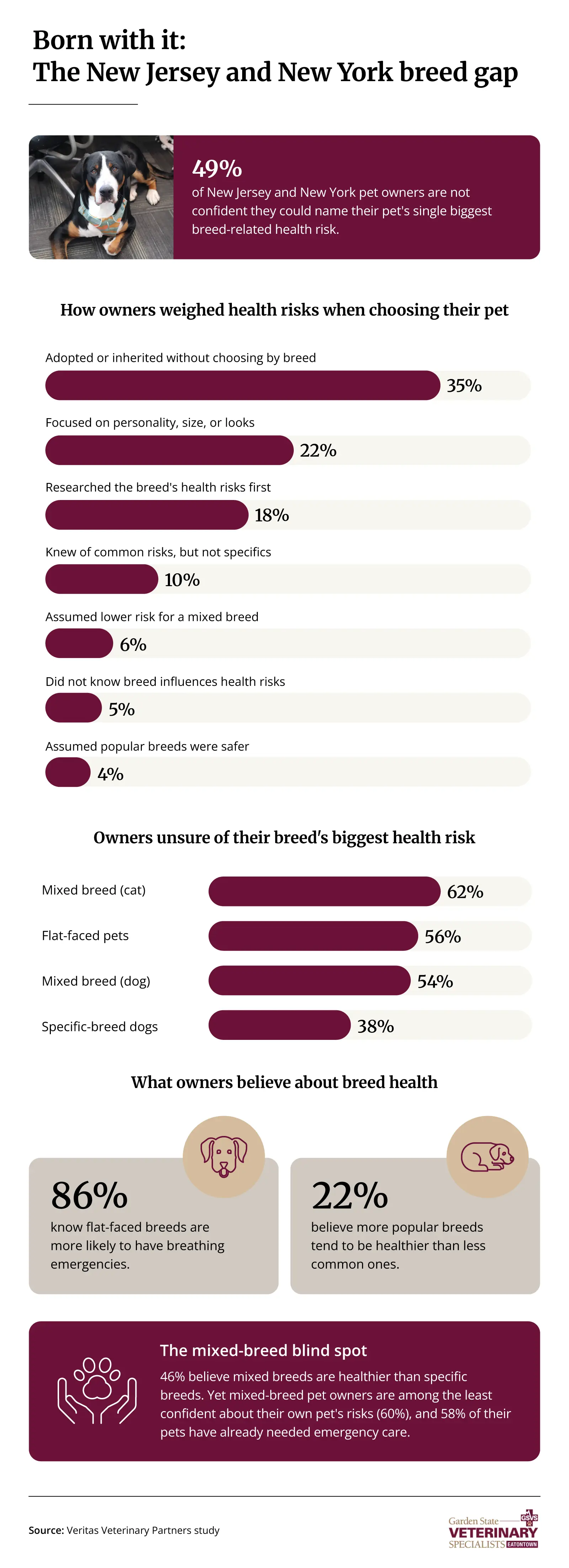
Nearly half of local owners (49%) couldn't confidently name their pet's single biggest breed-related health risk; 20% were very confident, 32% somewhat, 31% not very, and 18% not at all. The path to ownership helps explain this: 35% adopted or inherited their pet without choosing by breed, and only 18% researched a breed's health risks first.
Mixed-breed cat owners were the least sure group about their pet's biggest health risk (62%), which is unsurprising given that mixed-breed pets have no single breed profile to draw on, and the majority of flat-faced pet owners also landed on the unsure side (56%). Mixed-breed cats here include Domestic Shorthairs and Domestic Longhairs, the standard terms for cats without a specific documented breed, alongside owners who described their cat as a mix. Cat owners trailed dog owners in confidence, with 59% not confident versus 40% for dog owners.
Overall, 86% of owners were aware that flat-faced breeds face a higher risk of breathing problems. Nearly half (46%) believed mixed breeds are healthier than specific breeds. We also asked whether a breed's built-in health risks are mostly out of an owner's control, and 45% said they are. In practice they aren't. Weight management, breed-specific screening, and knowing which symptoms warrant an ER visit all change how a predisposition plays out. The Staten Island area owners were more than twice as likely as the rest of New Jersey to believe popular breeds are healthier than nonpopular ones (31% vs. 13%).
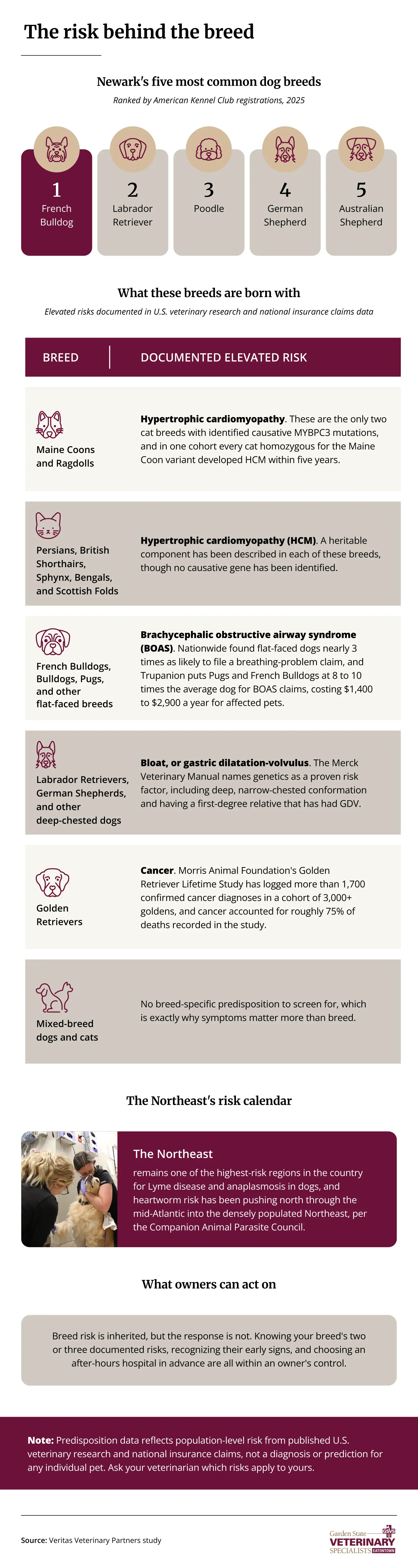
The American Kennel Club's (AKC) 2025 registrations rank the French Bulldog, Labrador Retriever, Poodle, German Shepherd, and Australian Shepherd as Newark's five most popular dog breeds, the nearest New Jersey metro ranking available. Nationwide's analysis of more than 50,000 brachycephalic dogs found flat-faced dogs nearly three times as likely to file a breathing-problem claim, and Trupanion puts Pugs and French Bulldogs at eight to 10 times the average for brachycephalic obstructive airway syndrome (BOAS) claims, at $1,400 to $2,900 a year for affected pets.
The Merck Veterinary Manual names Standard Poodles, Newark's third most popular breed, among the dogs most frequently affected by bloat, and Cornell University's College of Veterinary Medicine notes it can occur in any breed but is far more common in large, deep-chested dogs. For Golden Retrievers, popular across the New Jersey and Staten Island area, owners need to be aware of cancer concerns. The Golden Retriever Lifetime Study has logged more than 1,700 confirmed cancer diagnoses among the 3,000-plus goldens that were studied.
As for breed-specific risks among cats, Ragdolls and Maine Coons are the only two cat breeds with identified causative MYBPC3 mutations for hypertrophic cardiomyopathy (HCM), and a heritable component has been described in Persians, British Shorthairs, Sphynx, Bengals, and Scottish Folds, breeds that are well represented locally.
Mixed-breed dogs lead the local emergency list
For local pets, the emergency room turned out to be a common destination rather than a remote possibility.
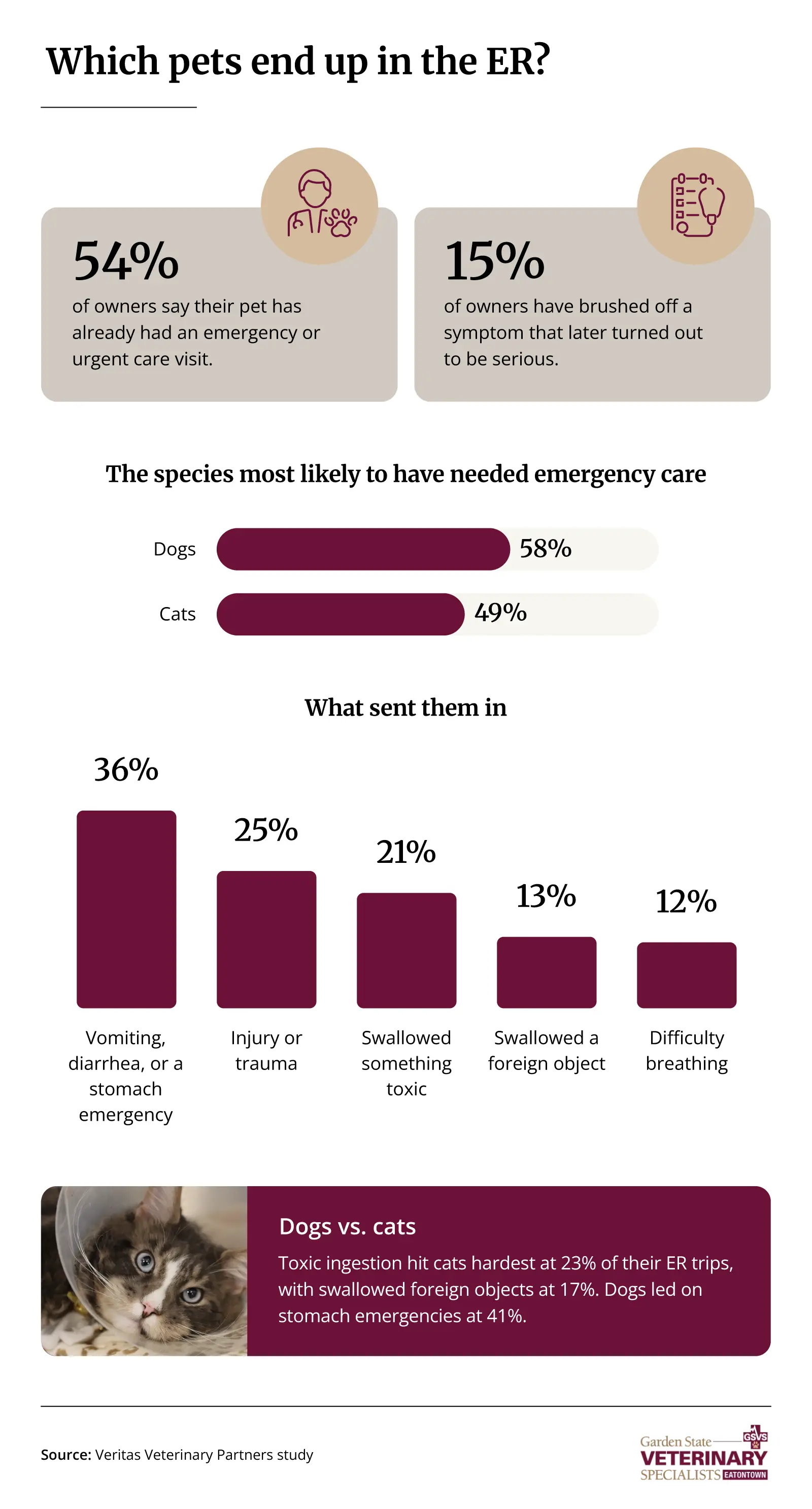
More than half of local owners (54%) said their pet has already needed emergency or urgent care, showing that these situations are far from rare. Across all emergency visits, stomach issues were the most common cause (36%), followed by injury or trauma (25%), toxic ingestion (21%), swallowed foreign objects (13%), and breathing trouble and urinary blockages (12% each).
Some pets were much more likely than others to end up in the ER. According to their owners, mixed-breed dogs had the highest emergency rate, with 69% needing emergency care, compared to 58% of dogs overall. Flat-faced pets had the lowest rate at 36%.
The reasons for emergency visits also differed by species. Toxic ingestion was the leading concern for cats, accounting for 23% of their ER trips, while swallowed foreign objects accounted for another 17%. For dogs, stomach emergencies dominated, driving 41% of emergency visits.
Emergency visits also varied by owner demographics. Pets owned by millennials had an emergency rate of 63%, compared with 40% for Gen X owners. Meanwhile, 15% of owners reported ignoring a symptom that later became serious, though no baby boomer respondents did so.
Owners worry about heat and toxins, but few feel unprepared for anything
Owners named the hazards that worry them, then named far fewer that they feel unready for.
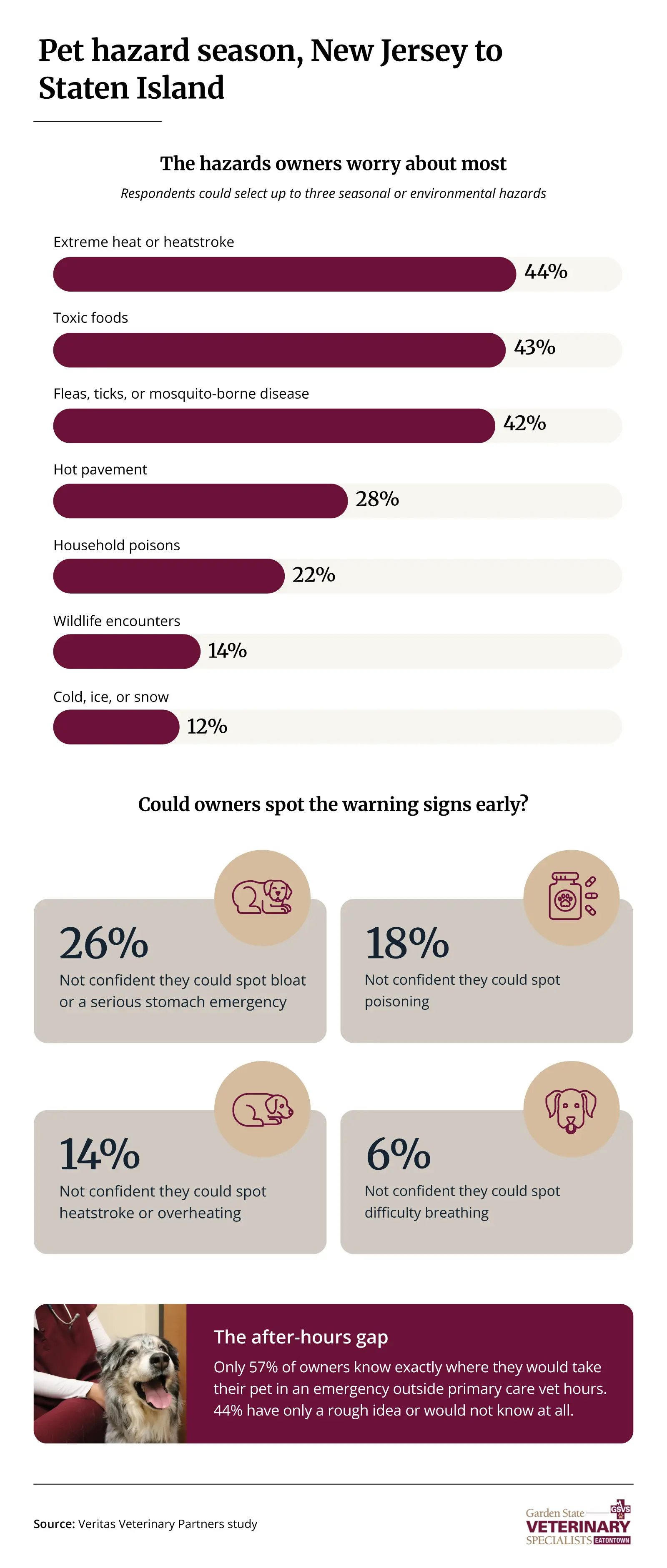
Extreme heat (44%), toxic foods (43%), and fleas and ticks (42%) were the seasonal hazards local pet owners worried about most. ASPCA Poison Control logged more than 376,000 reported exposures nationally in 2025, with food and drink second at 16%, supporting local worry about toxic foods.
The Northeast also remains one of the highest-risk regions in the country for Lyme disease and anaplasmosis in dogs. The Companion Animal Parasite Council reports that heartworm risk is pushing northward through the mid-Atlantic into the densely populated Northeast, with southern New Jersey already in the high-risk band. Owners can check their county on CAPC's free pet disease alert maps.
Asked separately which single hazard they felt least prepared to handle, the most common answer wasn't a specific threat: nearly 1 in 5 (19%) said nothing in particular, followed by extreme heat (11%) and foxtails (10%). Despite that confidence, some important knowledge gaps remained. More than a quarter of owners (26%) weren't confident they could recognize the early signs of bloat, while 18% said the same about poisoning and 14% about heatstroke.
Most owners did know where they would go in an after-hours emergency, however. More than half (57%) said they knew exactly where to seek care, another 38% had a general idea, and just 6% weren't sure. Dog owners were more likely than cat owners to have an after-hours plan (62% vs. 52%).
When one ER visit needs a specialist
An emergency visit was frequently the start of a larger medical case for local pets.
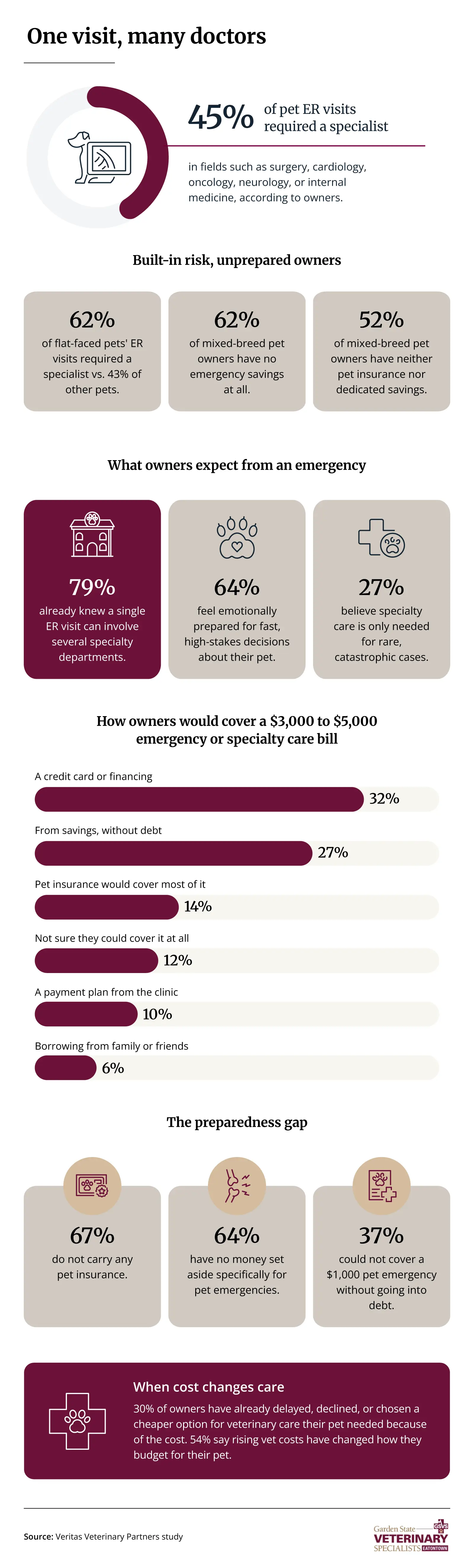
Among owners whose pet has been to the ER, nearly half (45%) said the visit required a specialist, in fields such as surgery, cardiology, oncology, neurology, or internal medicine, showing that an emergency visit is often just the beginning of treatment. Flat-faced pets were especially likely to need advanced care, with 62% of their emergency visits leading to specialty services, compared with 43% for all other pets.
Most owners (79%) already understood that a single emergency can involve multiple specialists, though 27% still believed specialty care is only needed for rare catastrophes. About two-thirds (64%) felt emotionally prepared for an emergency, while 54% said rising veterinary costs had already changed how they budget for their pets.
Financial preparedness, however, told a different story. More than a third of owners (37%) couldn't cover a $1,000 emergency without going into debt, 64% had no money set aside for pet emergencies, and 67% had no pet insurance for this pet. Some owners had one but not the other, which leaves 48% with neither a cushion nor a policy. The ASPCA reported this year that 60% of U.S. pet owners lack confidence that they could afford a pet medical emergency, which makes this market's 37% relatively strong by national standards.
Advanced cases require advanced care, and that carries higher costs. A hospital staffed around the clock with board-certified specialists is a different operation from a primary care practice, with different equipment, staffing, and overnight capability. Take one of the most common stomach emergencies. Surgery to clear an intestinal blockage in a dog averages $4,817 in New Jersey and $5,170 in New York, against a $4,383 national average, according to CareCredit, drawing on a 2025 Synchrony procedural cost study. For cats, foreign body removal averages $2,604 in New Jersey and $2,799 in New York. Those are cost-research figures, not pricing at any Veritas hospital. That's why we asked owners how they would pay a bill in that range.
Faced with a $3,000 to $5,000 veterinary bill, 32% said they would rely on a credit card, 27% would use savings, and 14% would turn to insurance, while 12% weren't sure how they would pay. Cost had already affected care decisions for 30% of owners, who said they had delayed, declined, or downgraded treatment because of the expense.
Among mixed-breed pet owners, 67% had no emergency savings, 58% had neither savings nor insurance, and only 19% of mixed-breed cats were insured. The generational divide was also striking: 46% of Gen Z owners couldn't cover a $1,000 emergency without going into debt, compared with just 12% of baby boomers.
Staten Island and New Jersey owners were more likely than those elsewhere in New Jersey to believe specialty care is only for catastrophic cases (32% vs. 22%), yet they were also better financially prepared, with 39% lacking both savings and insurance compared with 58% of owners elsewhere in New Jersey.
What local owners can do before the next emergency
The most useful preparation happens before symptoms appear. Owners who learn their pet's top breed-related risks, take even vague symptoms seriously, and plan an after-hours care strategy in advance give their pets a meaningful head start. The finances deserve the same attention, since a dedicated cushion or an insurance policy can keep the second half of an emergency from being about affordability.
Methodology
To explore how well pet owners in New Jersey and Staten Island understand their pets' breed-related health risks and how prepared they are for veterinary emergencies, we surveyed 200 dog and cat owners via online survey panels from June 22 to July 14, 2026. Of these, 101 respondents (51%) lived in Staten Island and neighboring New York and New Jersey zip codes, and the remaining 99 (49%) lived elsewhere in New Jersey. These regions reflect the markets served by the GSVS Family of Hospitals.
Respondents who owned more than one pet were asked to answer about the single pet they would be most worried about in a medical emergency. Among respondents, 52% answered about a dog and 48% about a cat; 54% were women, 45% were men, and 1% were non-binary. All respondents were adults ages 18 and older. By generation, 25% were Gen Z (ages 18 to 29), 44% were millennials (ages 30 to 45), 24% were Gen X (ages 46 to 61), and 8% were baby boomers (ages 62 and older).
Questions about the causes of emergency visits and the escalation into specialty care were asked only of the 108 respondents whose pet had experienced an emergency or urgent-care visit. Percentages for multi-select questions are based on all respondents shown the question and may total more than 100. All figures are rounded to the nearest whole percentage, so some totals may not equal 100.
This report also draws on published U.S. data. Breed commonality reflects American Kennel Club 2025 registration statistics for Newark. Breed predisposition figures come from Nationwide's analysis of more than 50,000 brachycephalic dogs; Trupanion claims data; Morris Animal Foundation's Golden Retriever Lifetime Study, an ongoing cohort of more than 3,000 dogs; the Merck Veterinary Manual; the American College of Veterinary Surgeons; the Dog Aging Project's analysis of 47,444 dogs; Cornell University's College of Veterinary Medicine; and published research on feline hypertrophic cardiomyopathy genetics.
Seasonal and toxin figures come from ASPCA Poison Control's 2025 exposure data. Emergency surgery costs come from CareCredit's published state-level averages, based on a 2025 Synchrony Average Procedural Cost Study conducted by ASQ360° Market Research, and are not pricing at Veritas hospitals.
Breed categories reflect what owners reported. "Specific-breed" means the owner identified a single breed rather than a mix; it does not imply registry documentation.
Affordability comparisons are based on a 2026 ASPCA survey and the PetSmart Charities-Gallup State of Pet Care study. Predisposition data describes population-level risk, not a diagnosis or prediction for any individual pet. Regional tick-borne and heartworm risk comes from the Companion Animal Parasite Council's 2025 Pet Parasite Forecast; county-level maps are available free at petdiseasealerts.org.
About GSVS Family of Hospitals
The GSVS Family of Hospitals is a family of emergency and specialty veterinary hospitals, with locations in Eatontown, Woodbridge, Toms River, and Staten Island. Our teams of board-certified specialists and emergency clinicians provide advanced, compassionate care across a full range of disciplines, including cardiology, neurology, oncology, surgery, critical care, and more. 24/7 emergency services are available 365 days a year, because when your pet's health depends on it, waiting isn't an option.
Fair use statement
This content may be shared or referenced for noncommercial purposes. We ask that any use include proper attribution to the GSVS Family of Hospitals and a link back to the original source.
The information contained in the article is for informational purposes only and is not intended to take the place of the advice of a veterinarian.